A clinical care plan.
Nursing and therapy may support recovery or maintain function. Medicare home health generally requires being homebound, qualifying intermittent skilled services, provider certification and a Medicare-certified agency.
THE COMMONWEALTH EDITION
LIFE / CARE / FINANCIAL PROTECTIONIllustrative connections, not office or service locations.
A clearer picture.
A more confident next step.
For Pennsylvania families, paying for care at home often means coordinating Medicare, Medical Assistance and a household’s own resources. Community HealthChoices and LIFE are different pathways; neither makes every request for household help an approved benefit.
Pennsylvania licensing has not been confirmed. This is educational information; product-specific recommendations, quotes and applications require confirmed licensing, appointments and availability.
CARE AT HOME / PENNSYLVANIA DHS
Home health care, nonmedical help and supplemental insurance are different things. Begin with the actual tasks and the hours needed, then identify which program or policy may help.
Nursing and therapy may support recovery or maintain function. Medicare home health generally requires being homebound, qualifying intermittent skilled services, provider certification and a Medicare-certified agency.
Bathing, dressing, meals and housekeeping can be essential. Medicare may cover qualifying part-time aide services while you also receive qualifying skilled care. Personal care alone, when that is the only help needed, is not covered.
Read Medicare’s home health requirements ↗
Community HealthChoices (CHC) serves eligible adults age 21 or older who have both Medicare and Medicaid, or qualify for Medicaid long-term services and supports. Eligibility exclusions apply. Access to home-based LTSS requires the applicable clinical and financial review and an authorized service plan; CHC enrollment alone is not approval for unlimited personal care.
Official program guidance ↗Living Independence for the Elderly (LIFE) may be an alternative for people age 55 or older who meet the required level of care, live in a LIFE service area and can be served safely in the community. Financial eligibility or private payment also matters. LIFE uses its own care team and plan; it is not a cash-benefit insurance rider.
Official program guidance ↗Pennsylvania’s home and community-based programs have different eligibility and service rules. Ask DHS or the Independent Enrollment Broker which pathway fits your age, disability and care needs, and how to apply. Confirm the assessment, service authorization and provider arrangements before assuming a requested caregiver will be paid.
Official program guidance ↗Douglas Benefits Group does not currently offer Medicare products or individual major-medical health insurance. Supplemental insurance does not replace comprehensive health coverage.
LIFE INSURANCE IN PENNSYLVANIA
In Pennsylvania, life insurance decisions often begin with the people and commitments that would remain: housing, family support, a dependent’s long-term needs or business obligations. Compare the time each responsibility lasts, not only the first premium on a proposal.
A defined period, generally without cash value. Compare the level-premium term, renewal pricing and conversion deadlines. Often considered for obligations with an end date.
Explore term life ↗Lifetime protection when required premiums and policy conditions are met. Generally includes fixed scheduled premiums and guaranteed cash values, with higher initial premiums than comparable term coverage. Dividends, if offered, are not guaranteed.
Explore whole life ↗Flexible premiums and death benefits within contract limits. Charges continue even when payments change. Inadequate funding can lead to lapse; any no-lapse guarantee has conditions.
Explore universal life ↗Universal life with interest crediting linked to an external index. Caps, participation rates or spreads may apply. Policyowners do not directly invest in the index, and crediting floors do not eliminate charges or lapse risk.
Explore indexed universal life ↗For a household balancing a mortgage and support for an aging parent or dependent, separate temporary costs from lasting commitments. A benefit chosen years ago may no longer match today’s responsibilities. Account for income, caregiving, debts and education, then subtract resources intended for those needs.
Age, health, tobacco use, occupation, amount and policy design can affect underwriting and premiums. Eligibility is not guaranteed. Any policy guarantees depend on the issuing insurer’s claims-paying ability and contract terms.
HOSPITAL INDEMNITY / A SEPARATE ROLE
Hospital indemnity insurance may pay a stated benefit after a qualifying covered hospital event. A need for care at home does not, by itself, establish a hospital claim.
Before discharge, ask whether the stay was classified as inpatient admission or observation. An overnight stay or emergency-room visit is not automatically a covered admission under a hospital indemnity contract.
Ask about event definitions, waiting periods, exclusions and daily or total limits. Money received may help with household costs, but that does not mean each expense is itself insured or reimbursed.
Read the hospital indemnity guide ↗PENNSYLVANIA / BEFORE YOU SIGN
Pennsylvania’s life insurance consumer guide describes a free-look period of at least ten days after receiving a policy. Keep proof of delivery and read the specific notice for the applicable deadline, return steps and refund terms. Special replacement or product rules may apply; do not assume every policy has the same period.
Read the official source ↗The Pennsylvania Insurance Department warns about stranger-originated life insurance arrangements in which an outside investor benefits from a policy on your life. Offers framed as zero-premium or no-cost insurance can affect taxes, benefits and future insurability. These are not ordinary family-protection purchases.
Read the official source ↗Pennsylvania’s Insurance Department accepts insurance questions and complaints through its Consumer Services Bureau. Keep the application, policy, illustration and written communications. Ask the insurer for an explanation first when appropriate, and use the Department’s research tools to verify companies and agents.
Read the official source ↗Last reviewed October 28, 2026. Verify current requirements with the responsible agency. State resources do not establish Douglas Benefits Group’s licensing or product availability.
A LITTLE CLARITY TO KEEP
Start reading here. When you’re ready, confirm your email to receive the complete guide—at no cost.
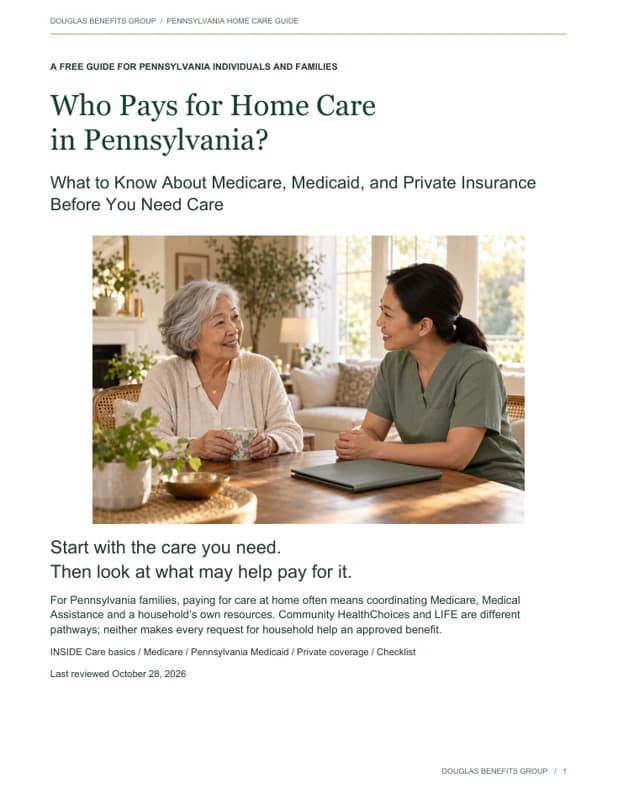
PENNSYLVANIA / HOME CARE · 7 PAGES
Explore Medicare, Pennsylvania’s CHC and LIFE pathways, private coverage limits and a practical care checklist.
Start Reading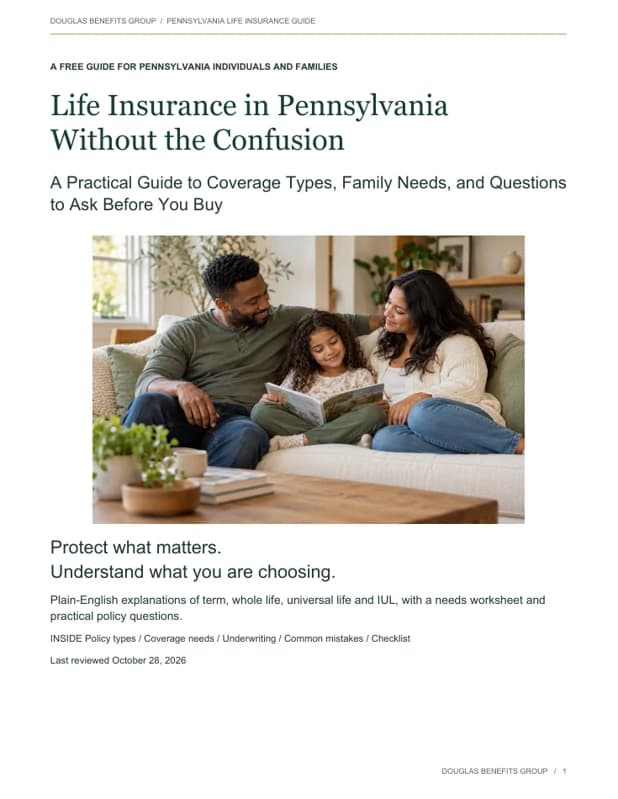
PENNSYLVANIA / LIFE INSURANCE · 8 PAGES
Understand term, whole life, UL and IUL, estimate your needs and learn about Pennsylvania policy-review rights and consumer safeguards.
Start ReadingANSWERS WITHOUT THE JARGON
Philadelphia, Pittsburgh, Harrisburg, Allentown and other communities can have different provider arrangements. These are geographic references, not office locations or confirmed service areas.
Explore the resource library ↗For later-life planning, explore Retirement & Annuities, annuity basics and fixed indexed annuities.
Pennsylvania licensing has not been confirmed. This is educational information; product-specific recommendations, quotes and applications require confirmed licensing, appointments and availability.
Medicare may cover qualifying part-time or intermittent home health aide services while you also receive qualifying skilled nursing or therapy and meet the home health benefit requirements. Personal care alone, when that is the only care you need, is not covered.
Pennsylvania’s home and community-based programs have different eligibility and service rules. Ask DHS or the Independent Enrollment Broker which pathway fits your age, disability and care needs, and how to apply. Confirm the assessment, service authorization and provider arrangements before assuming a requested caregiver will be paid.
No. A hospital indemnity policy generally requires a qualifying covered hospital event. A need for a home aide does not by itself establish a claim. Benefits, limits and exclusions depend on the contract.
Start with the responsibility, how long it lasts and a sustainable premium budget. Term life generally addresses a defined period. Whole life and universal life can address longer needs but have different costs, guarantees and management requirements. No type is best for everyone.
Yes. Each guide has an open preview with a useful first section. To receive the full PDF, request it by email and explicitly confirm your address. Marketing updates are optional and not required for guide delivery.
No. Living Independence for the Elderly is a coordinated health and support program for eligible adults age 55 or older. It is different from life insurance and from a policy’s living-benefit rider. Service-area, level-of-care, financial or private-pay, and safe-community-care requirements apply.
Yes, you can request a meeting for general education and availability questions. Booking does not establish eligibility, bind coverage or authorize product-specific recommendations before licensing and appointments are confirmed.
START WITH A CONVERSATION
Douglas Benefits Group works with several insurance carriers to help you find coverage that fits your needs and budget, where licensing, appointments and availability permit.
Book a meeting for general education or ask about availability. A meeting does not confirm eligibility or put coverage in force.
Book a MeetingPennsylvania licensing has not been confirmed. This is educational information; product-specific recommendations, quotes and applications require confirmed licensing, appointments and availability. Educational only; not medical, investment, tax or legal advice. Douglas Benefits Group is not affiliated with Medicare or a government agency.
A BROADER NETWORK
Insurance carriers available through our agency’s network. Availability depends on the product, state and eligibility. Not every carrier offers every product in every state.












Carrier names and logos are the property of their respective owners.